Gutters are one of those home systems that most homeowners never think about until something goes wrong. When they are working properly they are invisible. When they fail, the problems they cause show up everywhere else: in your foundation, your basement, your fascia boards, your landscaping, and in some cases your interior walls and ceilings.
For homeowners in Alberta, where spring snowmelt, summer thunderstorms, and freeze-thaw cycles all put significant water load on a home’s drainage system in the same calendar year, a properly designed and installed gutter system is not optional. It is one of the most cost-effective investments you can make in the long-term protection of your home.
This guide covers everything you need to know about residential gutters: what they actually do, the damage that happens without them, the types and materials available, and what separates a properly installed system from one that will give you trouble within a few seasons.
What Do Gutters Actually Do?
The basic function of a gutter system is straightforward: collect rainwater and snowmelt as it runs off your roof and direct it away from your home through a network of channels and downspouts. But the consequences of that function go well beyond simply keeping the eaves dry.
Foundation Protection
This is the big one. When water pours off an uncontrolled roof edge during a heavy rain, it saturates the soil directly against your foundation. Over time, that repeated saturation creates hydrostatic pressure against basement walls, causes soil heave and settlement, and in homes with older or less robust waterproofing, leads directly to basement water infiltration. Foundation repairs are among the most expensive repairs a homeowner will ever face, with costs that can easily reach tens of thousands of dollars. A functioning gutter system that directs water away from the foundation through properly placed downspouts and splash pads is one of the most reliable ways to avoid that outcome.
Fascia and Soffit Protection
Gutters attach to the fascia board along the lower edge of your roof. When a gutter system is missing, undersized, or blocked with debris, water overflows and runs back over the fascia rather than into the channel. Fascia boards are constantly wet in these conditions, which leads directly to rot, paint failure, and eventual structural deterioration. In Alberta’s climate, water that saturates a fascia board and then freezes accelerates that damage dramatically. A gutter that is doing its job keeps the fascia dry, which is why gutter replacement and fascia replacement so often go hand in hand when a system has been neglected.
Erosion and Landscaping Protection
A roof sheds a significant volume of water during a moderate rainfall event. Without gutters, that water hits the ground in a concentrated stream at the drip line, eroding soil, destroying garden beds, and creating channels in the grade around the perimeter of the home. Over several seasons, this erosion can alter the grade of your yard in ways that actually direct more water toward the foundation rather than away from it, compounding the foundation risk described above.
Siding and Exterior Wall Protection
Uncontrolled roof runoff splashes back from the ground onto the lower courses of siding and exterior walls, keeping that surface wet for extended periods. This accelerates paint degradation, promotes mold and mildew growth on siding surfaces, and in homes with wood or fiber cement siding, increases the risk of moisture intrusion at joints and end cuts. Keeping roof water channeled away from the wall surface at the eave is one of the simplest and most effective ways to extend the life of your exterior cladding.
Types of Gutters: Which Is Right for Your Home?
The two most common gutter profiles installed on residential homes in Alberta are K-style and half-round. Each has its place, and the right choice depends on your home’s architecture, your drainage requirements, and your maintenance preferences.
K-Style Gutters
K-style gutters are by far the most widely installed gutter profile on residential homes across Canada. Their flat back and decorative front profile, which somewhat resembles crown moulding when viewed from the ground, allows them to mount flush against the fascia board and gives them a clean, finished appearance that complements most contemporary and traditional home styles.
K-style gutters have a higher water capacity than round or half-round gutters of the same width, which makes them well suited to Alberta’s heavy rainfall events and spring snowmelt periods. They are available in four-inch, five-inch, and six-inch widths, with five-inch being the standard for most residential installations and six-inch recommended for homes with large roof surfaces or steep pitches that concentrate runoff.
Half-Round Gutters
Half-round gutters have a traditional, rounded trough profile that was the standard on most homes built before the mid-twentieth century. They are more common on heritage and character homes where the rounded profile is more architecturally appropriate, and they have a slight drainage advantage in that their smooth interior has no corners or angles where debris can accumulate.
Half-round gutters are typically mounted on brackets rather than flush against the fascia, which gives them a slightly more prominent visual profile. They are available in aluminum, steel, and copper, with copper being a popular choice for heritage homes where longevity and a traditional aesthetic are both priorities.
Gutter Materials: Aluminum, Steel, and Beyond
Aluminum
Aluminum is the dominant gutter material for residential installations across Alberta and most of Canada, and for good reason. It does not rust, handles the freeze-thaw cycles of the Alberta climate without the corrosion issues that affect steel, is lightweight enough for straightforward installation, and is available in a wide range of colours that can be matched to your fascia and trim. Seamless aluminum gutters are formed on-site from continuous rolls of aluminum stock, eliminating the joints that are the most common source of leaks in sectional systems.
Aluminum gutters are available in standard thickness, typically 0.027 inches, and a heavier gauge of 0.032 inches. The heavier gauge resists denting from hail and ladder contact, holds its shape better under snow and ice load, and generally has a longer service life. For Alberta homes where hail is a real seasonal risk, the heavier gauge is worth the modest additional cost.
Steel
Galvanized and Galvalume steel gutters offer greater structural strength than aluminum and are a good choice for homes where very heavy snow or ice load is a concern. The trade-off is that steel requires more maintenance to prevent corrosion at cut ends and damaged areas, is heavier and more difficult to install, and typically costs more than aluminum. Galvalume steel, which uses a zinc-aluminum alloy coating rather than pure zinc, offers significantly better corrosion resistance than standard galvanized and is the better choice when steel is the right material for the application.
Copper
Copper gutters are a premium product typically specified for heritage homes, custom builds, and applications where longevity and visual character are priorities. Copper does not rust, develops a protective patina over time, and can last fifty years or more with minimal maintenance. The cost is substantially higher than aluminum or steel, and installation requires a contractor experienced with copper work to ensure watertight soldered joints. For the right home, copper gutters are a genuinely worthwhile long-term investment.
Seamless vs. Sectional Gutters
This distinction matters more than most homeowners realize. Sectional gutters are sold in fixed lengths, typically ten feet, and are joined together with connectors on-site. Every joint in a sectional gutter system is a potential leak point. The sealants used at joints degrade over time, particularly through Alberta’s freeze-thaw cycles, and once a joint begins to leak it is only a matter of time before water is running behind the gutter and down the fascia.
Seamless gutters are formed on-site from a continuous roll of material cut to the exact length of each run. The only joints in a seamless system are at the corners and where downspouts connect, which are unavoidable. Eliminating the mid-run joints removes the most common failure point in a gutter system and is the primary reason seamless gutters have become the standard for professional residential installations.
At Kirkland Roofing and Exteriors, we install seamless aluminum gutters fabricated on-site to the precise dimensions of your home. Every run is cut to length and every connection is properly sealed and supported, which is why our gutter installations perform reliably through Alberta’s full range of seasonal conditions.
Signs Your Gutters Need to Be Replaced
Many homeowners wait too long to replace gutters that have passed their useful life, often because gutter problems develop gradually and the damage they cause accumulates in places that are not immediately visible. Here are the signs that indicate your gutter system needs professional attention:
- Gutters pulling away from the fascia or visibly sagging between hangers, which indicates either hanger failure or rot in the fascia board behind the gutter
- Visible rust staining, holes, or sections of gutter that are physically separating at joints
- Water marks or paint staining on the fascia board directly behind the gutter, indicating overflow or back-of-gutter leaks
- Pools of water collecting at the foundation after rainfall, or persistent wet areas in the basement following heavy rain
- Erosion channels in the soil at the drip line around the perimeter of your home
- Mold or mildew growth on siding at the lower courses, particularly near downspout locations
- Gutters that are more than fifteen to twenty years old and have not been inspected recently
In some cases, blocked gutters that have never been cleaned can look structurally intact from the ground but be carrying standing water, organic debris, and the weight of ice that is causing hidden damage to the gutter itself and to the fascia behind it. If your gutters have not been inspected in several years, a professional assessment is worth having before the next heavy weather season.
What Proper Gutter Installation Involves
The difference between a gutter installation that performs well for fifteen or twenty years and one that starts causing problems within a few seasons comes down almost entirely to installation quality. Here is what a proper residential gutter installation should include:
Correct Pitch
Gutters need to slope toward the downspout at a rate of approximately one quarter inch of drop for every ten feet of run. Too little slope and water sits in the gutter rather than flowing to the outlet, creating conditions for debris accumulation, standing water, mosquito breeding, and ice formation in winter. Too much slope and the gutter becomes visually noticeable from the ground and may not align properly with the fascia profile.
Adequate Hanger Spacing
Gutters in Alberta need to support not just the weight of water but the weight of wet leaves, accumulated debris, and in winter, ice. Hangers spaced too far apart allow the gutter to flex and sag under load, which disrupts the slope, creates low points where water pools, and eventually pulls fasteners out of the fascia. Professional installations use hanger spacing of no more than two feet in Alberta’s climate to account for the additional load of ice and snow.
Proper Downspout Sizing and Placement
A gutter system is only as effective as its ability to drain the water it collects. Undersized downspouts or too few downspouts for the roof area being drained create backups during heavy rain events. In general, one downspout per thirty to forty feet of gutter run is the standard for typical residential roof pitches, with higher pitch roofs requiring more frequent outlet spacing. Downspouts also need to extend far enough from the foundation, at least six feet, or connect to an underground drainage system, to ensure that the water they discharge does not simply pool against the wall.
End Caps, Mitre Joints, and Sealant
Every open end of a gutter run needs a properly fitted and sealed end cap. Every inside and outside corner needs a mitred joint or formed corner piece that is sealed watertight. These are the details that separate a professional installation from a rushed one, and they are where leaks develop when corners are cut.
How Kirkland Roofing and Exteriors Can Help
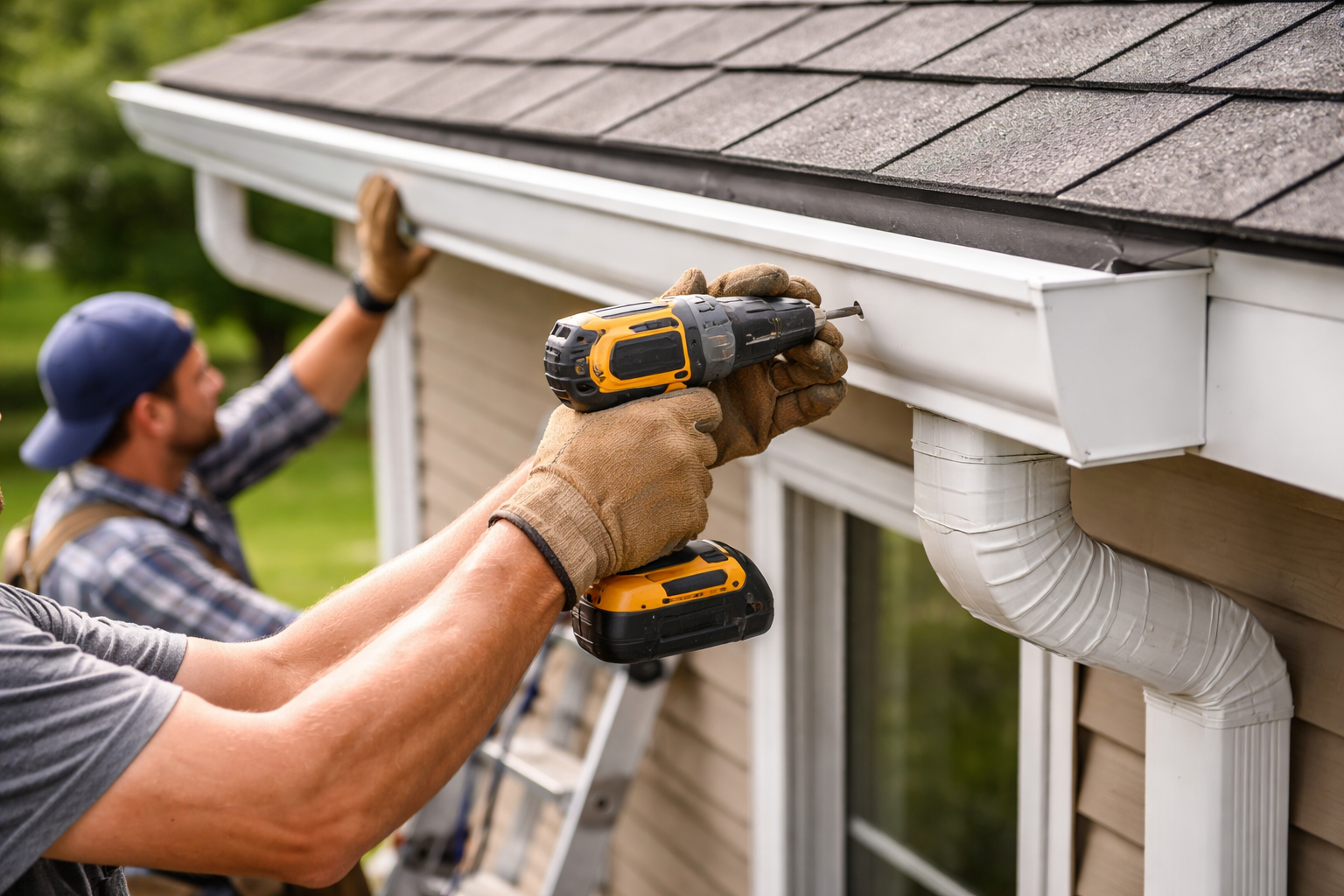
At Kirkland Roofing and Exteriors, gutter installation is part of a complete exterior system that includes roofing, soffit, fascia, and siding. We install seamless aluminum gutters fabricated on-site to the exact dimensions of your home, with proper pitch, correct hanger spacing, and fully sealed connections throughout.
We serve homeowners across Parkland County, Edmonton, St. Albert, Spruce Grove, Stony Plain, Sherwood Park, and Fort Saskatchewan. Whether you are replacing a failing gutter system, installing gutters on a home that has never had them, or coordinating a gutter installation as part of a broader roofing and exterior project, we provide a free inspection and transparent quote with no surprises.
Final Thoughts
Gutters are doing quiet but essential work on your home every time it rains or the snow starts to melt. When they are doing that work properly, you never notice them. When they fail, the damage they allow shows up in your foundation, your fascia, your siding, and your basement, often in ways that cost significantly more to repair than a proper gutter system would have cost to install.
If your current gutters are aging, pulling away from the fascia, or simply not performing the way they should, do not wait for the damage to become obvious. Contact Kirkland Roofing and Exteriors today for a free inspection and quote. Call us at (780) 554-0397 or visit kirklandroofingandexteriors.ca. We serve Parkland, Edmonton, and all surrounding communities across Alberta.