
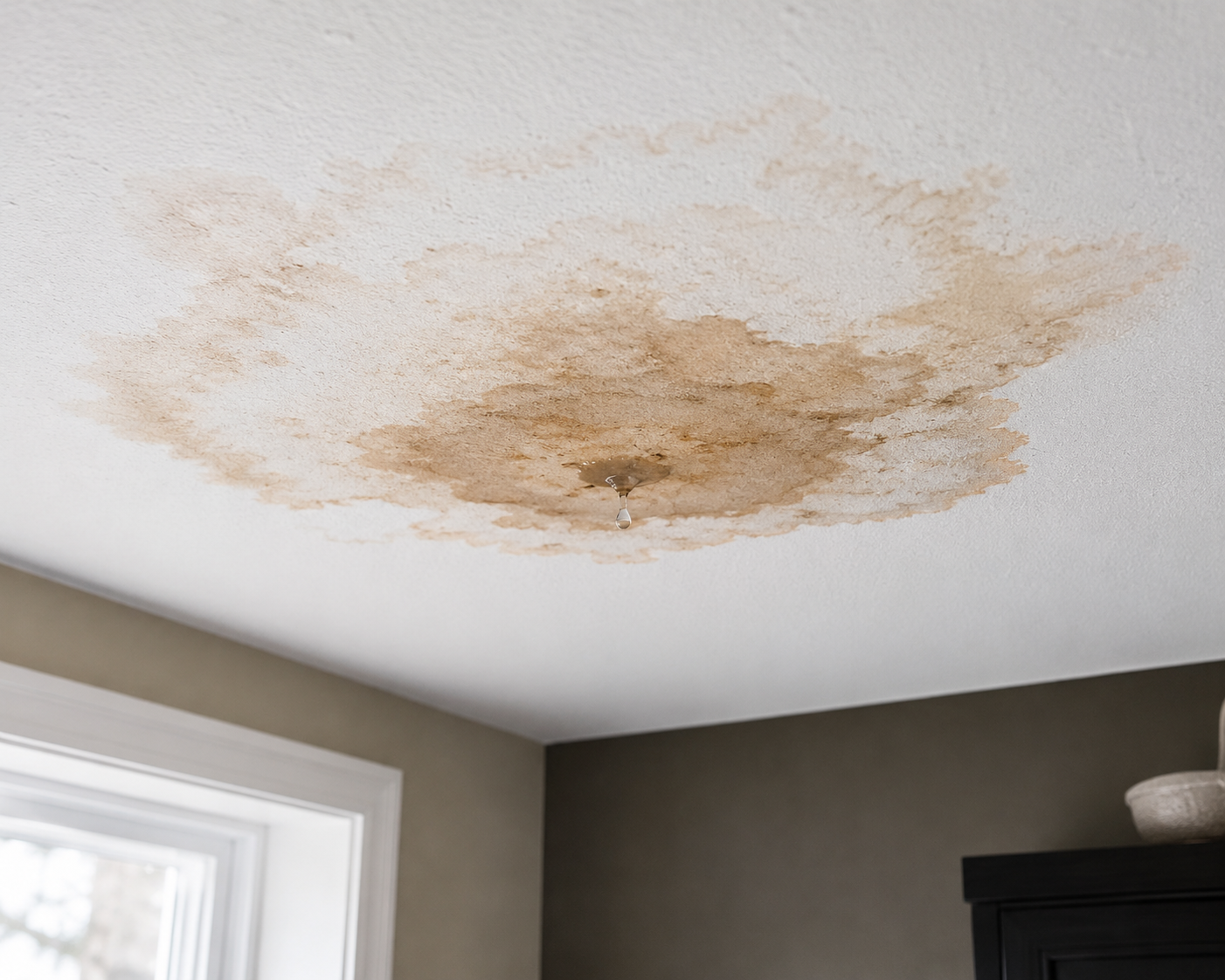
A water stain appearing on your ceiling is one of the most unsettling things a homeowner can discover, because it means water has already travelled through your roof structure and reached the interior of your home. By the time that stain is visible, the leak has usually been active for longer than most people realize, and the water entry point on the roof is almost never directly above where the stain appears inside.
This is what makes roof leaks particularly frustrating to diagnose and why so many attempted DIY repairs fail to solve the problem. A homeowner notices a stain in the corner of a bedroom ceiling, goes up on the roof and applies sealant to the area directly above it, and discovers the following wet season that the leak is still active. Water does not travel in straight lines through a roof structure. It follows framing members, runs along sheathing, and travels horizontally along vapour barriers before it finds a low point and drips onto a ceiling surface that may be several metres from the actual entry point.
This guide explains the most common causes of roof leaks in Alberta homes, how water moves through a roof assembly in ways that make leaks deceptive to trace, and the systematic approach to finding and correctly identifying the actual source of a leak rather than treating symptoms while the underlying cause continues.
Why Roof Leaks Are Harder to Diagnose Than They Look
The gap between where a leak appears inside a home and where water is actually entering the roof structure is the central challenge of leak diagnosis. Understanding why this gap exists helps you approach the problem more systematically.
Water that enters through a compromised point on the roof surface, whether a failed flashing seal, a cracked shingle, or a gap around a pipe penetration, does not immediately drip straight down to the ceiling below. It follows the path of least resistance through the roof assembly. On a sloped roof, that typically means running down the slope of the roof deck until it reaches a rafter, then following the rafter downward until it reaches the top plate of the wall, then potentially running horizontally along that plate before dripping onto a ceiling surface. The ceiling stain that appears may be two, three, or even five metres away from the actual water entry point.
This water travel behaviour explains why the stain in the corner of a second-floor bedroom may be coming from a failed pipe boot in the middle of the roof, or why a stain near an interior wall may be traced to a flashing failure at a valley on the opposite side of the roof from where it appears. Diagnosing a roof leak correctly requires understanding these travel pathways and tracing water back to its source rather than treating the stain as a reliable indicator of where to look.
The Most Common Causes of Roof Leaks in Alberta
Failed or Deteriorated Flashing
Flashing failure is the single most common cause of roof leaks in Alberta homes and accounts for a large proportion of the leaks that roofing professionals are called to diagnose and repair. Flashing is the metal sealing system at every joint, penetration, and transition in the roof, and it is responsible for waterproofing the locations that shingles alone cannot protect.
The most leak-prone flashing locations in Alberta homes are chimney flashings, where the counter flashing embedded in mortar joints deteriorates as the mortar breaks down over time; step flashings along dormers and wall transitions, where improper installation or sealant failure creates gaps; and pipe boot flashings around plumbing vents, where the rubber collar cracks and splits after ten to fifteen years of UV and freeze-thaw exposure.
Flashing leaks are particularly deceptive because they often allow only small amounts of water to enter during light rain but produce significant infiltration during heavy rain or snowmelt events when larger water volumes are being directed through the roof system. A flashing leak that appears minor based on interior staining can be moving substantial amounts of water into the wall cavity and insulation in ways that are not immediately visible.
Damaged or Missing Shingles
Shingles that have been cracked, lifted, or displaced by wind, hail, or physical damage create direct openings in the roof surface through which water can enter. In Alberta, hail damage is a particularly common cause of shingle compromise. A hailstone that cracks a shingle may not create an immediate leak, but the crack allows water infiltration that progresses with each subsequent rain event and accelerates with freeze-thaw cycling as water enters the crack and expands.
Wind-lifted shingles are another common Alberta issue, particularly on roofs where shingles were not adequately sealed down during installation or where the seal strip has degraded over time. A shingle that is lifted but still in place may not be visibly obvious from the ground but creates a pathway for wind-driven rain to enter the roof assembly at the lifted edge. During Alberta’s spring and summer storm season, wind-driven rain that enters under lifted shingles is a frequent cause of localized leaks that appear during storms and seem to dry out between rain events.
Clogged or Damaged Gutters Contributing to Ice Dams
While gutters themselves sit below the shingle line and do not directly cause roof leaks, blocked or damaged gutters in Alberta’s climate create the conditions for ice dam formation that does cause leaks. When gutters are blocked with debris and cannot drain meltwater effectively, that water refreezes at the eaves and builds into an ice dam that backs water up under the shingles. The resulting water infiltration appears as ceiling stains and wet insulation in the attic, often near the exterior walls of the top floor.
Ice dam leaks have a characteristic pattern: they typically appear during warm spells in winter or during rapid snowmelt in spring rather than during rain events, and they are concentrated near the eaves rather than in the interior of the ceiling. If leaks appear in winter or early spring but not during summer rain, ice dam formation from blocked gutters and inadequate attic insulation is the most likely cause.
Cracked or Deteriorated Pipe Boots and Vent Flashing
Every plumbing vent stack and mechanical exhaust penetrating through the roof requires a sealed flashing to prevent water from entering around the pipe. The most common type is a pipe boot or vent flashing with a rubber collar that seals against the pipe surface. This rubber collar has a service life of approximately ten to fifteen years in Alberta’s climate before UV radiation and freeze-thaw cycling causes it to crack, split, or pull away from the pipe surface.
A failed pipe boot creates a direct water entry point around the pipe penetration that allows water to run down the outside of the pipe and into the roof structure below. Because the pipe runs vertically through the roof deck, water that enters at a failed boot can travel down the pipe and appear as a ceiling stain or drip point directly below the bathroom or kitchen where the vent pipe originates, making it appear to be a plumbing leak rather than a roofing problem.
Valley Failures
Roof valleys, the V-shaped channels where two sloping roof planes meet, carry a concentrated volume of water from both roof surfaces down to the gutters. Because of this concentrated water flow, valley flashing and the shingles at the valley are under more sustained water exposure than any other part of the roof surface. Over time, valley flashing can corrode, the mineral surface of valley shingles can erode from the constant water flow, and the underlying materials can deteriorate to the point where water infiltrates through the valley rather than flowing down it.
Valley leaks typically produce staining on interior ceilings that follows a line below the valley location. Because valleys run diagonally across the roof, the staining pattern on the ceiling below may appear to follow an angled line rather than a point source, which can help identify the valley as the likely leak origin even before getting on the roof.
Skylight Leaks
Skylights are a common source of roof leaks, though the leak is more often a flashing failure around the skylight frame than a failure of the skylight unit itself. The flashing that seals the transition between the skylight frame and the surrounding shingles on all four sides is subject to the same degradation mechanisms as other roof flashings, and the corners where adjacent flashing sections meet are particularly vulnerable.
Skylight leaks often present as staining on the ceiling directly below the skylight, which makes them easier to trace to source than many other roof leaks. However, the staining may also appear on the side walls of the skylight shaft rather than on the ceiling below, depending on the water travel path through the shaft framing.
Attic Condensation
Not every ceiling stain or wet attic condition is caused by water entering through the roof from outside. In Alberta’s cold winters, inadequate attic insulation and ventilation can cause condensation to form on the underside of the cold roof sheathing when warm, humid air from the living space rises into the attic. This condensation drips onto the attic insulation and eventually onto the ceiling below in a pattern that can be indistinguishable from an active roof leak to the untrained eye.
The distinguishing characteristic of condensation versus an active roof leak is the pattern relative to weather conditions. A roof leak typically produces staining or dripping during or shortly after rain events. Condensation-related moisture in the attic tends to be more persistent and is often worst during cold weather when the temperature differential between the warm living space and the cold attic is greatest. If moisture appears in the attic during dry winter cold snaps rather than during rain, condensation from inadequate insulation and ventilation is the more likely cause.
How to Systematically Find a Roof Leak
Finding the actual source of a roof leak rather than treating where it appears inside the home requires a systematic approach that traces water backward from the interior stain to the exterior entry point.
Start in the Attic
The attic is the most valuable diagnostic space for tracing a roof leak because it sits between the interior ceiling and the exterior roof surface and often preserves evidence of the water travel path. During or shortly after a rain event, go into the attic with a good flashlight and look for:
- Active drips or wet spots on the underside of the roof sheathing or on the top of the insulation
- Staining or discolouration on rafters and sheathing that shows where water has travelled in the past
- Daylight visible through the roof deck, which indicates a physical opening
- Mold or mildew growth on framing members or sheathing, which indicates persistent moisture rather than a single event
- The direction the staining runs on framing members, which shows which way water is travelling and points back toward the entry point
If you can find the point where water is actively entering or where historic water travel staining originates on the sheathing, measure its distance from the ridge and from the nearest gable end. You can use these measurements to identify the approximate location on the exterior roof surface to inspect.
Check the Obvious Suspects First
Before searching the entire roof surface, check the locations that are statistically most likely to be the source of any given roof leak. In order of likelihood for Alberta homes:
- Pipe boots and vent flashing collars — inspect each one for cracking, splitting, or separation from the pipe surface
- Chimney flashing — check counter flashing for separation from mortar joints and step flashing for gaps at the sides and back
- Roof valleys — look for thin or eroded mineral surface on valley shingles and corrosion or gaps in valley flashing
- Skylights — check all four sides of the frame for flashing gaps, particularly at the corners
- Step flashing along any dormer or wall transition — look for lifted or separated flashing pieces and gaps in sealant
- Any location where a roof penetration exists that is not clearly and completely sealed
The Garden Hose Test
If the attic inspection and exterior visual check do not clearly identify the source, a systematic water test can help isolate it. With one person inside the attic watching for water entry and another on the roof with a garden hose, start at the lowest point of the roof and work upward in sections, wetting each area for several minutes before moving higher. When the person in the attic sees water beginning to enter, the section being wet at that moment contains the leak source.
This test requires two people and some patience, but it is the most reliable method for isolating a leak source that is not evident from visual inspection alone. Work slowly and methodically, wetting one section at a time rather than the entire roof, so the entry point can be localized rather than simply confirmed as somewhere on the roof.
When to Call a Professional
Roof leak diagnosis is straightforward in concept but requires access to the roof, knowledge of what to look for at each potential leak location, and the experience to distinguish between an active leak source and historic staining from a problem that has already been addressed. If your attic inspection and roof check do not clearly identify the source, or if the roof pitch, height, or condition makes safe access difficult, a professional inspection is the appropriate next step.
A roofing professional who regularly diagnoses and repairs roof leaks has the pattern recognition to identify likely sources quickly and the experience to distinguish between the various mechanisms that produce similar interior symptoms. Misdiagnosing a roof leak and applying sealant to the wrong location wastes money and time while the actual leak continues to damage the roof structure and interior.
What to Do While Waiting for Repairs
If you have an active leak and cannot get a professional on the roof immediately, there are steps you can take to limit interior damage while you wait:
- Place a bucket or container under the active drip point to capture water and protect the floor and furnishings below
- If water is pooling in a ceiling that shows signs of bulging or sagging, carefully puncture the low point with a screwdriver to allow controlled drainage rather than risking a sudden collapse of the saturated ceiling material
- Move furniture and valuables away from the affected area
- Document the leak with photos and video, particularly if a recent storm may have caused the damage and an insurance claim is possible
- If you can safely access the roof and the leak source is clearly identified, a temporary cover of heavy plastic sheeting or a quality tarp secured over the affected area can reduce water entry until permanent repairs are made
How Kirkland Roofing and Exteriors Can Help
At Kirkland Roofing and Exteriors, roof leak diagnosis and repair is one of our most common services for homeowners across Parkland County, Edmonton, St. Albert, Spruce Grove, Stony Plain, Sherwood Park, and Fort Saskatchewan. Our team has the experience to trace leaks back to their actual source rather than treating interior symptoms, and we provide honest assessments of what is causing the problem and what repair is needed to resolve it properly.
We do not apply sealant to the ceiling stain and call it fixed. We find the entry point, repair it correctly, and assess the surrounding area for any related vulnerabilities that could produce a new leak in the near future. When a leak has been active long enough to cause sheathing damage or mold growth in the attic, we identify and communicate that clearly so the full scope of the repair is understood before work begins.
Final Thoughts
Roof leaks are rarely as simple as they appear from the inside. The water stain on your ceiling is the end point of a journey that started somewhere on the roof exterior, often at a flashing, a failed pipe boot, or a damaged shingle, and travelled through your roof structure in ways that put the visible evidence well away from the actual problem. Understanding this helps you approach leak diagnosis more systematically and avoid the frustration of treating the wrong location while the real source continues to cause damage.
If you have an active or suspected roof leak and want a professional diagnosis and repair, contact Kirkland Roofing and Exteriors today. Call us at (780) 554-0397 or visit kirklandroofingandexteriors.ca. We serve Parkland, Edmonton, and all surrounding communities across Alberta.