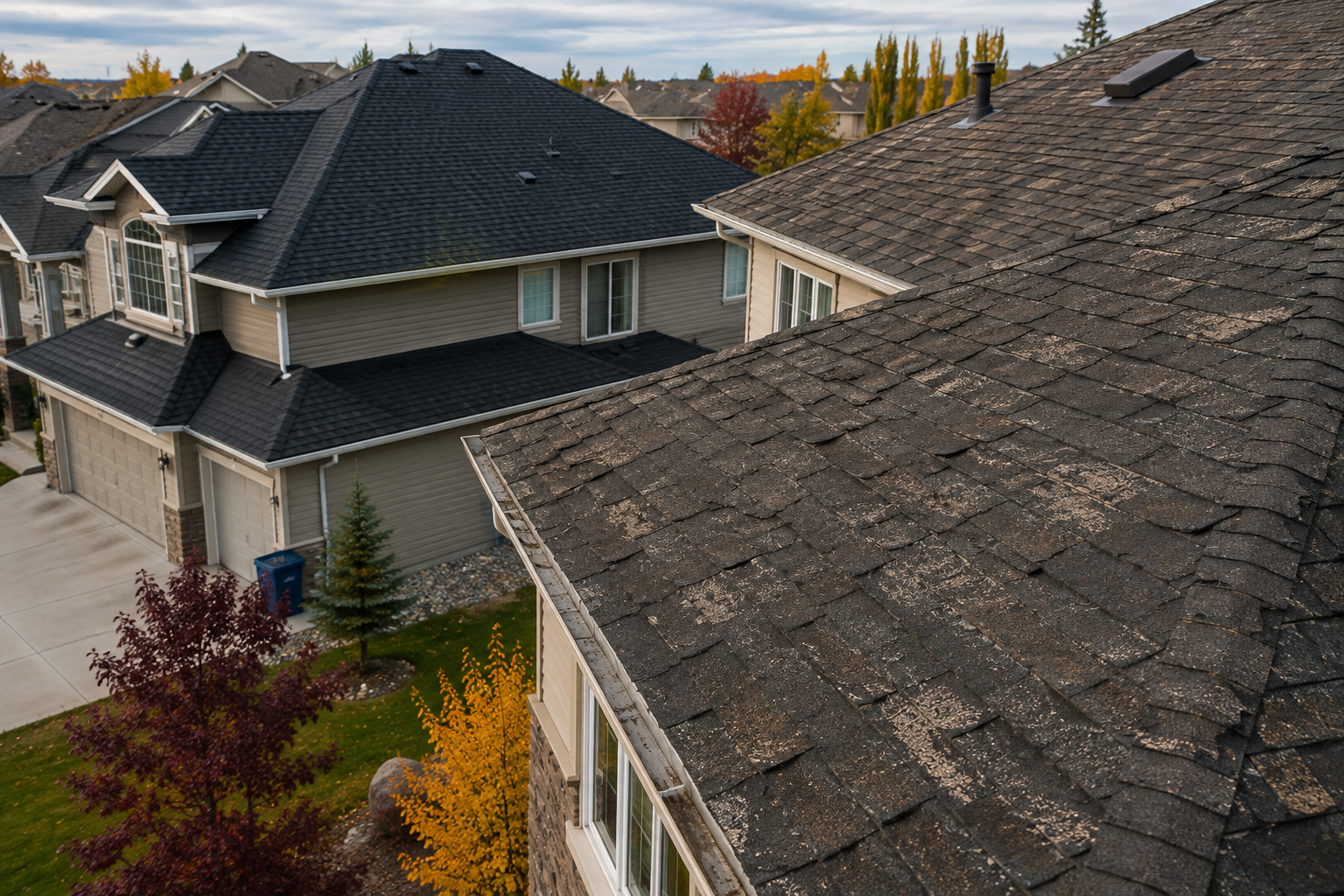
It is one of the most common questions homeowners ask when they are thinking about their roof: how long should this actually last? It is also one of the questions that gets the most inconsistent answers, because the honest answer depends heavily on what the roof is made of, how it was installed, how well the attic beneath it is ventilated, and perhaps most importantly in Alberta, how much punishment the climate has thrown at it.
A roof that would last thirty years in a mild, temperate climate may realistically last twenty to twenty-five years in Alberta. A roof that performs adequately in a low-hail region may show significant damage after a single summer in the Edmonton corridor. Understanding the realistic lifespan of different roofing materials in Alberta’s specific climate gives you a much more useful picture than the manufacturer’s rated lifespan alone, and helps you make better decisions about when to repair, when to replace, and what material to choose when replacement time comes.
This guide breaks down the realistic lifespan of every major roofing material used on Alberta homes, explains the specific factors that shorten or extend those lifespans, and gives you the signs to watch for that indicate your roof is approaching the end of its useful life.
Why Alberta’s Climate Is Harder on Roofs Than Most
Before getting into material-specific lifespans, it is worth understanding why Alberta roofs age faster than the same materials would in other parts of Canada or North America. Several factors combine to create an unusually demanding environment for roofing materials.
Hail
Alberta is one of the most hail-active regions in Canada, and the Edmonton to Calgary corridor sees some of the most severe hail events in the country. Hailstones large enough to cause significant granule loss on asphalt shingles are not rare. Golf ball-sized hail that cracks shingles outright happens regularly. A single significant hail event can take five to ten years off the effective service life of a standard asphalt shingle roof by stripping the protective granule layer that shields the underlying asphalt mat from UV radiation.
This is one of the primary reasons asphalt shingle roofs in Alberta consistently underperform their rated lifespans. A thirty-year architectural shingle that has been through two or three significant hail events may be functionally at end of life in fifteen to eighteen years.
Freeze-Thaw Cycling
Alberta’s freeze-thaw cycling is relentless, particularly in the shoulder seasons. Spring and fall can bring multiple freeze-thaw cycles in a single week as temperatures fluctuate around the freezing point. Water that infiltrates any existing crack, gap, or compromised sealant expands when it freezes and forces the opening wider. Over multiple seasons of this repeated expansion and contraction, small vulnerabilities become large ones.
This mechanism is particularly damaging to materials with joints, seams, or areas where sealant is used as the primary waterproofing method, including asphalt shingles at flashings, cedar shakes at joints, and concrete or clay tiles at fastening points.
UV Radiation
Alberta’s high altitude and the intensity of summer sun at this latitude means UV radiation levels are significant during the summer months. UV radiation is one of the primary aging mechanisms for asphalt-based roofing materials. It breaks down the oils in the asphalt, causing shingles to become brittle, crack, and lose flexibility over time. The granule coating on asphalt shingles is specifically designed to block UV from reaching the asphalt beneath, which is why granule loss from hail impacts accelerates the aging process so dramatically.
Extreme Temperature Range
Few places in Canada experience the temperature range that Alberta does across a calendar year, from minus forty in January to plus thirty-five in July. This eighty-degree swing in ambient temperature causes significant expansion and contraction in all roofing materials. Metal expands and contracts with temperature changes. Asphalt shingles become stiff in extreme cold and soft in extreme heat. Fasteners work loose over time as the materials around them cycle through repeated dimensional changes. Managing this thermal movement through proper installation is essential to maximizing the service life of any roofing material in Alberta.
Roofing Material Lifespans: Alberta Reality vs Rated Lifespan
| Roofing Material | General Lifespan | Alberta Realistic Lifespan | Key Alberta Factors |
| Architectural Asphalt | 25–30 years | 20–25 years | Hail, UV, ventilation quality |
| Class 4 Impact Resistant | 30–40 years | 30–40 years | Minimal hail impact; ventilation key |
| Euroshield Rubber | 50+ years | 50+ years | Virtually unaffected by hail; handles freeze-thaw well |
| Metal (Steel/Aluminum) | 40–70 years | 40–60 years | Expansion/contraction; fastener quality |
| Cedar Shake | 20–30 years | 15–20 years | Moisture, freeze-thaw, maintenance demands |
| Concrete Tile | 40–50 years | 30–40 years | Freeze-thaw cracking; snow load; weight |
Material-by-Material Breakdown
Architectural Asphalt Shingles
Architectural shingles, also called dimensional or laminated shingles, are the current standard for residential roofing in Alberta. They are thicker than three-tab products, with a layered construction that creates a textured, dimensional appearance and provides better impact resistance. Rated lifespans of twenty-five to thirty years are common, with realistic Alberta expectations of twenty to twenty-five years for well-installed roofs on properly ventilated attics that have not been through multiple severe hail events.
The quality of architectural shingles varies significantly between product tiers. Entry-level architectural shingles from major manufacturers are a meaningful step up from three-tab products but still represent the lower end of the performance spectrum. Premium architectural shingles with heavier base mats, higher granule loading, and higher wind and impact ratings perform meaningfully better in Alberta’s conditions and are worth the additional cost for homeowners who plan to own their home for the long term.
Class 4 Impact Resistant Shingles
Class 4 impact resistant shingles are the highest impact resistance rating available in the roofing industry, meaning they have passed a standardized test involving a two-inch steel ball dropped from prescribed heights without cracking or fracturing. In practical Alberta terms, this means they handle all but the most extreme hail events without the granule loss and bruising that compromises standard asphalt shingles.
Realistic lifespans of thirty to forty years are achievable in Alberta for Class 4 products on properly installed and ventilated roofs. Many Alberta home insurers recognize the reduced claim risk of Class 4 roofing and offer premium discounts of fifteen to thirty percent, which can offset a meaningful portion of the additional material cost over the life of the roof.
Euroshield Rubber Roofing
Euroshield is a rubber roofing product made from recycled tires that is manufactured in Alberta and specifically engineered for Canadian climate conditions. It carries a Class 4 impact resistance rating, handles freeze-thaw cycling without the brittleness that affects asphalt products in cold temperatures, and is rated for fifty years of service life with minimal maintenance requirements.
In Alberta’s specific conditions, Euroshield’s realistic lifespan genuinely approaches and often exceeds fifty years. It is the most durable roofing option available for Alberta homes and the only product that can honestly be described as a long-term solution to hail damage rather than a better version of a product that still gets damaged. The higher upfront cost of Euroshield is offset over time by its dramatically longer replacement cycle, reduced maintenance requirements, and the insurance premium discounts it qualifies for.
Kirkland Roofing and Exteriors is a certified Euroshield installer and has been installing this product across Parkland County and the Edmonton region for over a decade. It is the product we most commonly recommend for homeowners who want to stop replacing their roof every fifteen to twenty years.
Metal Roofing
Steel and aluminum metal roofing products are significantly more durable than asphalt in most respects. Metal roofing does not granulate, does not crack under UV exposure, and is generally more resistant to wind damage than shingle products. Rated lifespans of forty to seventy years are common for quality metal roofing systems.
In Alberta’s climate, realistic lifespans of forty to sixty years are achievable, with the main performance considerations being the quality of the fastening system and the management of thermal expansion and contraction. Metal roofs that use exposed fasteners require periodic inspection and refastening as the thermal cycling of Alberta’s temperature range works fasteners loose over time. Standing seam metal roofing systems that use concealed fasteners handle thermal movement better and require less maintenance.
Metal roofing also performs well in Alberta’s hail environment, though large hailstones will dent softer aluminum products visibly. The denting is typically cosmetic rather than functional, but it is worth understanding when setting expectations for a metal roof’s appearance over time in a hail-active area.
Cedar Shake
Cedar shake roofing was a popular choice in Alberta for many decades and a significant number of older homes in the Edmonton and Parkland County area still have cedar shakes in place. Cedar is a naturally durable wood with good resistance to moisture and insects when properly maintained, and rated lifespans of twenty to thirty years are achievable in favourable conditions.
In Alberta’s climate, realistic lifespans are typically fifteen to twenty years, and the maintenance requirements to achieve even that are significantly higher than for any other material on this list. Cedar shakes need to be cleaned of moss, lichen, and organic debris regularly. They need to be treated periodically to maintain their moisture resistance. They are vulnerable to freeze-thaw cycling at joints and at the fastening points where moisture infiltrates. In Alberta’s modern insurance environment, cedar shake roofs are also increasingly difficult and expensive to insure, which is a practical consideration for homeowners with aging shake roofs.
Most cedar shake roofs in Alberta that are approaching or past their service life are being replaced with architectural asphalt, Class 4, or Euroshield products rather than like-for-like shake replacements, both because of the maintenance demands and the insurance implications.
Concrete Tile
Concrete tile roofing is less common in Alberta than in milder climates but it does appear on some homes, particularly higher-end properties built in the 1990s and 2000s. Concrete tile carries rated lifespans of forty to fifty years and performs well in warm, dry climates. In Alberta’s climate, realistic expectations should be adjusted to thirty to forty years, with the primary concerns being freeze-thaw cracking over time, the weight of snow load on tile roofs that were not structurally designed to handle it, and the fact that individual tiles that crack or break need to be matched and replaced with care.
Concrete tile is one of the roofing materials that benefits most from professional inspection after significant hail events, as the tile surface shows impact damage clearly but individual cracked tiles may not be immediately obvious from the ground.
Factors That Shorten Roof Lifespan in Alberta
Beyond the material itself, several specific conditions and maintenance failures consistently shorten roof lifespans in Alberta. Understanding these helps you both protect a roof that is in good condition and recognize when a roof has been compromised beyond what maintenance can address.
Inadequate Attic Ventilation
This is the single most common and most impactful factor in shortened asphalt shingle roof life in Alberta. An attic that is too warm in winter creates ice dam conditions that cause water infiltration and physical damage to the roofline. An attic that is too hot in summer accelerates the aging of the shingles from below, cooking the asphalt and dramatically shortening the shingle’s service life. Manufacturer warranties on asphalt shingles are voided by inadequate ventilation precisely because its impact on product life is so well documented.
A properly ventilated attic maintains a temperature close to the outdoor ambient temperature year-round through a balanced intake and exhaust ventilation system. Soffit vents provide cold air intake at the eaves; ridge vents or high roof vents allow warm air to exit at or near the peak. Any blockage in this system, from insulation covering soffit vents, insufficient vent area, or a mismatch between intake and exhaust capacity, compromises the thermal performance of the attic and accelerates shingle aging.
Hail Damage Left Unaddressed
A significant hail event that strips granules from asphalt shingles and is not followed by professional assessment and appropriate repair or replacement accelerates the aging of the affected shingles dramatically. The exposed asphalt mat oxidizes rapidly under Alberta’s UV radiation, becoming brittle and cracking within a few seasons. What might have been a roofing product with ten years of remaining life after a hail event can become a leaking roof in three to five years if the hail damage is not assessed and addressed.
Poor Original Installation
Improper nailing, inadequate underlayment, poor flashing installation, and insufficient shingle overlap are all installation failures that shorten service life and void warranties. A roof installed improperly may perform adequately for several years before the installation deficiencies manifest as active problems, but it will not achieve its rated service life. This is one of the strongest arguments for choosing an experienced, certified roofing contractor over the lowest-cost option, particularly for a full replacement project.
Deferred Maintenance
Minor issues that are identified and not addressed compound over time. A small flashing gap that allows minimal water infiltration in year five becomes a source of significant sheathing rot by year eight. A partially blocked gutter that contributes to modest ice dam formation in year three becomes a source of fascia rot and interior ceiling damage by year six. Addressing small problems promptly is consistently less expensive than addressing the larger problems that develop when maintenance is deferred.
Signs Your Roof Is Approaching End of Life
Regardless of material and age, the following indicators suggest a roof is reaching or has passed the point where ongoing repairs are more economical than replacement:
- Widespread granule loss across multiple roof slopes, leaving large areas of exposed asphalt mat visible from the ground or on close inspection
- Shingles that are curling upward at the edges or cupping upward at the centres across large sections of the roof rather than in isolated spots
- Multiple active leaks or ceiling stains developing within a short period, indicating that the waterproofing system has broken down in more than one location
- Sheathing that is soft or spongy when walked on, indicating moisture damage to the structural deck beneath the shingles
- A roof that is approaching or past the upper end of its realistic service life for the material type and Alberta’s climate conditions
- Flashing failures developing at multiple locations simultaneously, suggesting the entire roof system is aging rather than isolated failures
- Increasing frequency of required repairs that are costing cumulatively more than a portion of a replacement project annually
How Kirkland Roofing and Exteriors Can Help
At Kirkland Roofing and Exteriors, we provide free roof assessments for homeowners across Parkland County, Edmonton, St. Albert, Spruce Grove, Stony Plain, Sherwood Park, and Fort Saskatchewan. Our assessments give you an honest picture of your roof’s current condition, a realistic estimate of its remaining service life, and a clear recommendation on whether repair or replacement makes more sense given the material, the age, and the specific condition of your roof.
When replacement is warranted, we walk you through the material options that make sense for your home, your budget, and your plans for the property. Whether that means an architectural asphalt product that delivers solid value, a Class 4 impact resistant shingle that reduces insurance costs, or Euroshield rubber roofing for the homeowner who wants to stop thinking about their roof for the next fifty years, we give you the information you need to make the right call.
Final Thoughts
The lifespan of a roof in Alberta is not simply a function of what the warranty says. It is the product of the material chosen, how it was installed, how well the attic beneath it is managed, and how the specific conditions of Alberta’s climate, particularly hail, freeze-thaw cycling, and UV radiation, have treated it over time. Understanding these factors gives you a realistic framework for planning and budgeting for roof maintenance and replacement rather than being caught off guard when a roof fails sooner than expected.
If you are uncertain about the current condition of your roof or where it sits in its service life, contact Kirkland Roofing and Exteriors today for a free assessment. Call us at (780) 554-0397 or visit kirklandroofingandexteriors.ca. We serve Parkland, Edmonton, and all surrounding communities across Alberta.