
Alberta is one of the most active hail corridors in Canada. The Edmonton and Parkland County region sits directly in a zone where severe hail events occur regularly throughout the summer months, and the storms that produce golf ball-sized hail stones capable of significant structural damage are not rare occurrences here. They happen every year.
After a hail storm passes, most homeowners do a quick visual check from the ground, see no obvious holes or missing shingles, and conclude that their roof came through unscathed. The problem is that the most significant and most costly hail damage to asphalt shingle roofs is not visible from the ground. It requires getting on the roof and knowing exactly what to look for.
This guide explains what hail damage actually looks like on different roofing components, why so much of it gets missed, when the damage is serious enough to warrant an insurance claim, and what the inspection and claims process looks like so you are not walking into it unprepared.
Why Hail Damage Is So Frequently Missed
The disconnect between what homeowners see from the ground and what is actually happening on their roof is one of the most common reasons hail damage goes unaddressed for months or years after a storm. There are several reasons this happens.
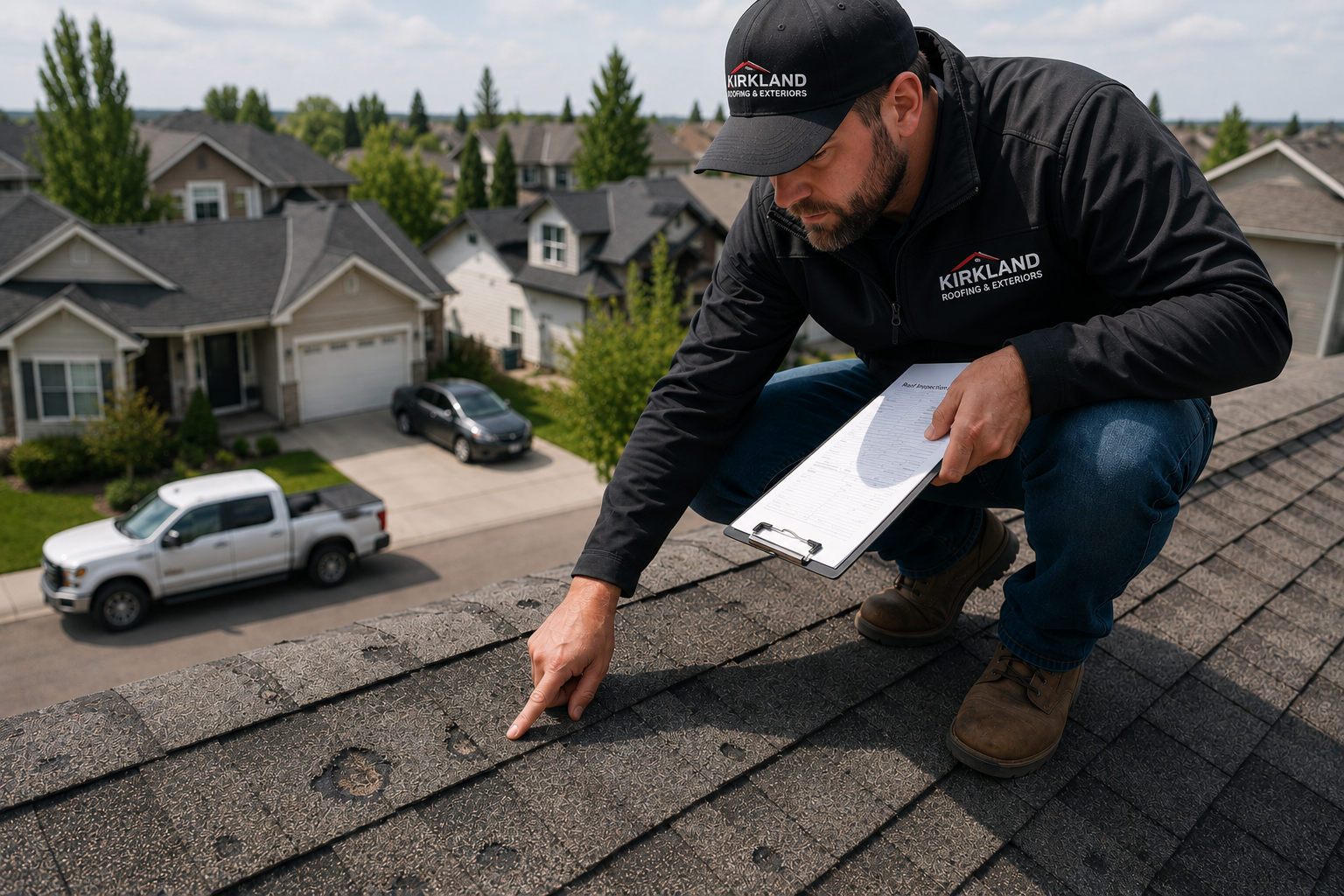
First, the most damaging impact of hail on asphalt shingles is granule loss. Asphalt shingles are coated with a layer of mineral granules that protect the underlying asphalt mat from UV radiation and provide the shingle’s fire resistance rating. When a hail stone strikes a shingle, it dislodges granules from the impact zone, exposing the dark asphalt mat beneath. From twenty feet away on the ground, this looks like a slightly darker patch or nothing at all. Up close, it is clearly visible as a circular area of bare or thinly covered asphalt with granules displaced to the surrounding area.
Second, hail damage accelerates roof deterioration rather than causing immediate failure. A roof with significant hail damage does not necessarily leak the week after the storm. The exposed asphalt mat begins to oxidize and crack under UV exposure. The shingle’s lifespan is shortened dramatically. Leaks typically begin to appear one to three years after the storm as the compromised areas of the shingle reach the end of their reduced service life. By the time the leak appears, the storm is long past and the connection between the hail event and the damage is not obvious.
Third, most insurance policies have a time limit on filing storm damage claims. In Alberta, most residential property policies require claims to be filed within one to two years of the date of the damage. Homeowners who discover hail damage late are sometimes outside the window to make a valid claim, even though the damage is clearly storm-related.
What Hail Damage Looks Like on Asphalt Shingles
Identifying genuine hail damage on asphalt shingles requires understanding what you are looking for and distinguishing it from normal wear, mechanical damage, or manufacturing defects. Here is what a professional inspector looks for:
Random Pattern of Impact Marks
Hail damage appears in a random pattern across the roof surface because hail stones fall at varying angles and strike different points across the shingle field. This randomness is one of the key characteristics that distinguishes hail damage from other types of shingle deterioration. Age-related granule loss tends to be uniform across the entire shingle surface. Manufacturing blistering produces a consistent pattern tied to the manufacturing process. Hail impacts are scattered and random.
Circular Granule Loss With Exposed Mat
The signature of a fresh hail impact on an asphalt shingle is a roughly circular area of granule loss with the dark asphalt mat exposed at the centre. The edges of the impact zone may show displaced granules. On a recent storm, the exposed mat will be black or dark grey and noticeably different in appearance from the surrounding granule-covered surface. On older damage, the exposed mat will have begun to oxidize and may appear lighter or chalky grey as the asphalt dries out.
Soft Spots or Bruising
Beyond the visible surface damage, hail impacts can create a soft spot in the shingle where the force of the impact has damaged the fiberglass mat beneath the asphalt layer. This is called bruising and it is one of the more serious indicators of hail damage because it compromises the structural integrity of the shingle even if the surface granule loss is relatively minor. Bruising is identified by pressing gently on the impact area and feeling for a soft, spongy response compared to the firm, rigid feel of undamaged shingle.
Cracked or Split Shingles
Larger hail stones, particularly those above one inch in diameter, can crack shingles outright. Cracked shingles are more obviously visible than granule loss and represent a more immediate risk of water infiltration. In severe hail events, cracked and punctured shingles may be visible from the ground, though the more widespread pattern of granule loss damage typically extends well beyond the visibly cracked areas.
What Hail Damage Looks Like on Other Roof Components
A thorough hail damage inspection covers more than just the shingles. Several other components of your roof and exterior show hail damage in ways that are important for both the inspection and the insurance claim.
Gutters and Downspouts
Aluminum gutters and downspouts are softer than shingles and show hail impacts very clearly as small circular dents across the surface. Denting on gutters is one of the most reliable indicators of a significant hail event and one of the first things an experienced inspector will check when assessing a roof after a storm. If your gutters show consistent hail denting, it is a strong indication that your shingles have also sustained impact damage even if that damage is less visually obvious from the ground.
Soffit and Fascia
Aluminum soffit and fascia panels show hail impacts as dents and dings similar to gutters. On painted wood fascia, hail impacts may chip or crack the paint surface. Damage to soffit and fascia is documentable for insurance purposes and is typically included in a comprehensive storm damage claim alongside roof damage.
Flashing
Metal flashing at chimneys, valleys, pipe boots, and wall transitions can be dented by large hail, potentially disrupting the seal at critical waterproofing points. Flashing damage from hail is less common than shingle or gutter damage but should be checked during any comprehensive post-storm inspection, particularly around chimneys and skylights where the flashing is most exposed to direct impact.
Air Conditioning Units and Ventilation Caps
Rooftop air conditioning units, ridge vents, and other ventilation components with exposed metal surfaces show hail impacts clearly and are often used as supporting evidence in insurance claims to confirm the severity of the hail event that affected the property. Damage to these components that is consistent with hail is difficult for an insurer to dispute and strengthens the overall claim.
The Difference Between Hail Damage and Normal Wear
Insurance adjusters are trained to look for indicators that a homeowner is attributing normal age-related deterioration to storm damage, and legitimate hail damage inspections need to clearly differentiate between the two. Here are the key distinctions:
- Hail damage appears in a random, scattered pattern. Age-related granule loss is uniform across the shingle surface or concentrated at the tab edges where water flow is heaviest.
- Hail impact zones have defined circular edges. Granule loss from weathering has diffuse, irregular edges that blend into the surrounding surface.
- Hail bruising creates a soft spot at the impact centre. Blistering from manufacturing defects or heat creates a raised bubble rather than a depression.
- Hail damage is consistent with the direction the storm came from. Damage concentrated on the north-facing slopes of a roof during a storm that came from the north is directionally consistent and more credible than damage claimed on sheltered slopes.
- Denting on gutters, downspouts, and metal flashing is consistent with hail but not with normal weathering. If the metal shows consistent denting and the shingles show granule loss, the combination strongly supports a hail damage finding.
When Should You File an Insurance Claim?
Not every hail event warrants an insurance claim, and filing a claim for minor damage that falls below your deductible or causes minimal long-term impact is generally not in your best interest since claims history affects your future premiums. The threshold question for filing is whether the damage is significant enough to materially shorten the life of your roof or create a meaningful risk of water infiltration in the coming years.
A professional roof inspection after a significant hail event is the most reliable way to answer that question. Here are the indicators that make a claim worth pursuing:
- Hail impact density of more than eight to ten hits per ten square feet of shingle surface, which represents sufficient damage to meaningfully compromise the shingle’s protective function
- Exposed asphalt mat visible at multiple impact zones across all roof slopes, indicating that granule loss is widespread rather than isolated
- Bruising detected at a significant proportion of impact zones, indicating damage to the fiberglass mat beneath the surface
- Cracked or punctured shingles in addition to granule loss
- Consistent denting across gutters, downspouts, and metal components that confirms a significant hail event
- A roof that was already approaching the middle or later portion of its service life, where hail damage will accelerate deterioration significantly
If your roof is relatively new, say under five years old, and the damage is limited to minor granule loss at a low density, a claim may not be warranted. If your roof is ten or more years old and shows widespread impact damage, the case for filing is much stronger because the storm has effectively ended a significant portion of the roof’s remaining useful life.
The Insurance Claims Process: What to Expect
If you decide to proceed with a claim, understanding the process in advance makes it significantly less stressful. Here is how it typically unfolds for a residential hail damage claim in Alberta.
Step 1: Document the Storm
Before the inspection, gather any documentation of the hail event itself: the date of the storm, any news reports of the storm, local weather service reports confirming hail size in your area, and photos of any obvious damage to your property including vehicles, garden furniture, or other surfaces that show hail impact clearly. This documentation establishes that a hail event of sufficient severity occurred at your location on a specific date, which is the foundation of the claim.
Step 2: Get a Professional Inspection Before Calling Your Insurer
Having an independent professional inspection completed before you call your insurance company is strongly recommended. An experienced roofing contractor who knows how to identify and document hail damage can give you an objective assessment of what is on your roof and whether it is consistent with storm damage or normal wear.
This matters because insurance adjusters work for the insurer, not for you, and their initial assessment may not capture the full extent of the damage. Having a contractor’s inspection report to reference during the adjuster’s visit gives you an informed baseline and helps ensure that the full scope of damage is identified and included in the claim.
Step 3: File the Claim and Schedule the Adjuster Visit
Contact your insurance company to file the claim and schedule the adjuster visit. Have your inspection report, storm documentation, and photos ready. It is reasonable to ask that your roofing contractor be present during the adjuster’s inspection so that they can walk the adjuster through the damage findings and answer technical questions about what constitutes storm damage versus normal wear.
Step 4: Review the Adjuster’s Report
After the adjuster’s inspection, you will receive a report and an initial settlement offer. Review this carefully. If the adjuster’s finding differs significantly from your contractor’s assessment, you have the right to dispute the finding and request a re-inspection or an independent appraisal. Do not sign off on a settlement offer until you are confident it accurately reflects the scope of the damage and the cost of a proper repair or replacement.
Why Impact-Resistant Roofing Makes Sense in Alberta
After going through a hail damage claim and roof replacement, many Alberta homeowners take the opportunity to upgrade to a Class 4 impact-resistant roofing product. The Class 4 designation, which is the highest impact resistance rating in the industry, means the product has been tested against two-inch steel ball impacts at high velocity and maintained its integrity. In practical terms, a Class 4 roof can withstand most Alberta hail events without the granule loss and bruising that compromises a standard asphalt shingle.
Euroshield rubber roofing, which Kirkland Roofing and Exteriors installs across the Edmonton and Parkland region, is a Class 4 rated product made from recycled rubber that is specifically engineered for impact resistance. Many Alberta home insurance providers offer premium discounts of fifteen to thirty percent for homes with Class 4 impact-resistant roofing, which means the upgrade can pay for itself over time through reduced insurance costs while also eliminating the recurring cycle of hail damage and claims.
How Kirkland Roofing and Exteriors Can Help
At Kirkland Roofing and Exteriors, we provide professional post-storm hail damage inspections for homeowners across Parkland County, Edmonton, St. Albert, Spruce Grove, Stony Plain, Sherwood Park, and Fort Saskatchewan. Our inspections are thorough, documented, and honest. We identify what is actually there rather than inflating damage to generate work, and we give you a clear assessment of whether the damage warrants an insurance claim and what a proper repair or replacement would involve.
We are experienced in working alongside insurance adjusters and can be present during the adjuster’s visit to ensure the damage is properly assessed. If a roof replacement is warranted, we will walk you through your material options including the case for upgrading to a Class 4 impact-resistant product that reduces the likelihood of this situation repeating.
Final Thoughts
Hail damage to an Alberta roof is common, frequently underestimated, and often more serious than a ground-level inspection suggests. The combination of granule loss, bruising, and accelerated deterioration that follows a significant hail event can cut years off a roof’s service life and eventually lead to leaks and interior damage that could have been prevented with a timely claim and repair.
If your area has experienced a significant hail event and your roof has not been professionally inspected, do not assume it came through unscathed. The cost of a professional inspection is minimal compared to the cost of discovering storm damage two years later when it has progressed and the claims window has closed.
Contact Kirkland Roofing and Exteriors today to schedule a free hail damage inspection. Call us at (780) 554-0397 or visit kirklandroofingandexteriors.ca. We serve Parkland, Edmonton, and all surrounding communities across Alberta.